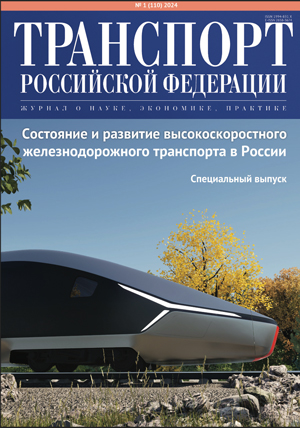
The journal "Transport of the Russian Federation" is intended for executives and leading specialists of the transportation complex and related industries, as well as representatives of the executive and legislative branches of the Russian Federation government. It is published with the support of the Ministry of Transport of the Russian Federation.
The journal covers topics such as transportation legislation, investments in the industry, the development of public-private partnerships, customs and transit policies of the state, implementation of transportation infrastructure projects, introduction of information technologies, ensuring safety in transportation, freight, and logistics, as well as professional training of personnel.
Current issue
ГОСУДАРСТВО И ТРАНСПОРТ
The systemic problems hindering the development of maritime arbitration in the Russian Federation are analyzed. A comparative analysis is carried out with leading foreign jurisdictions (England, Singapore) across key aspects: the arbitrability of disputes, procedural efficiency, and the enforcement of awards. Proposals are formulated for reforming the regulatory framework and the practice of the Maritime Arbitration Commission in order to enhance its competitiveness in the international arena.
ПРАВО
The problem of the discrepancy between the regulatory framework currently in force in the field of railway station and junction design and the present state of railway equipment and technologies is examined. Existing contradictions in the provisions of certain regulatory documents are noted. Proposals are formulated for the revision and updating of the design norms and rules under consideration.
ИНФОРМАЦИОННЫЕ ТЕХНОЛОГИИ
A method is proposed for the optimal selection of a digital technical and technological solution from a given set of alternatives on the basis of a multi-criteria assessment. The best option is selected on the basis of four heterogeneous criteria: the handling cost per railcar, the dwell time of a local railcar under the responsibility of OAO RZD, labor productivity, and occupational injuries. An example calculation using the proposed methodology is provided.
Under the influence of the breakthrough technologies of the Fourth Industrial Revolution — big data analytics, robotics, sensors, and communication facilities — the concept of the autonomous marine vessel is actively developing, opening up broad prospects for the future progress of the shipping industry. At the same time, this brings to the fore the issues of ensuring the safety of selfpropelled vessels through improved monitoring of their vital systems, which is one of the principal tasks in the maritime field. Certain issues of the situational assessment of engine condition on unmanned vessels using sensors and artificial intelligence technologies are considered.
ВЫСОКОСКОРОСТНОЕ ДВИЖЕНИЕ
A review is conducted of existing foreign solutions in the field of planning and operating a network of infrastructure facilities for the maintenance and repair of high-speed rolling stock. Based on a comparative analysis of the experience of Japan, Germany, and France, different conceptual approaches to the planning and siting of station infrastructure facilities are identified. A set of key principles is identified that is important to take into account when making decisions on their placement within the high-speed rail (HSR) network.
A method is investigated for determining the moment of onset of a failure associated with the absence of an automated monitoring system for the condition of the insulated rail joints of station track circuits located on crossovers between main tracks. A key diagnostic indicator is established: an asymmetric reduction in the resistance of an insulated rail joint below a threshold value (~20 Ohms) leads to a significant increase in the traction current flowing through it.
ЛОГИСТИКА
An analysis is conducted of the structural transformation of the maritime logistics system of the Northwestern Federal District as a result of the impact of sanctions restrictions during the 2022-2025 period. Based on official statistics, the dynamics of shipping volumes and changes in the territorial and modal structure of freight flows are examined. Three stages of adaptation are distinguished: shock, the formation of a new architecture, and postcrisis stabilization. It is established that the sanctions led to a profound redistribution of cargo among the regions.
ИНФРАСТРУКТУРА
The adaptation of the Hydro Power Tower technology developed at SPbPU for the tasks of emergency backup power for transport facilities is presented. The results of numerical simulation for the “Shlisselburg” prototype, designed for the conditions of the mouth of the Neva River, are provided. The design is described of a prefabricated, demountable hyperbolic tower made of composite materials, a vortex turbine, and a helical-pile foundation, ensuring mobility and operability under ice cover.
НАУКА И ТРАНСПОРТ
The features of the operation of an automatic speed control system for an electric locomotive with controlled excitation converters when hauling a freight train over track sections with a hilly profile are examined. The quality of its operation is assessed according to established criteria.
With the aim of developing recommendations for selecting the parameters of three-piece bogies that provide the required running performance in the empty condition for railcars with a tare weight of less than 21 t, digital simulation was carried out of the motion of freight railcars on three-piece bogies with various structural configurations on curved and straight track sections. Based on the calculations performed, new parameters are proposed for bilinear spring suspension and zeroclearance side bearers, ensuring compliance with the standards for the dynamic performance of railcars with a tare weight of less than 21 t in both the empty and loaded conditions.
ЭКОЛОГИЯ
Traffic noise in cities is analyzed as one of the hazardous factors harmful to the human habitat and health. The effects of the noise produced by vehicles on various systems of the human body are examined. Legal, administrative, technical, and other measures for limiting it are proposed.
ГОРОД И ТРАНСПОРТ
Based on an analysis of the actual structural parameters of the technical operation of the vehicles of urban public passenger transport, the problem of the low operating efficiency of production facilities is identified, resulting from the absence of coordinated development of the technological, organizational, and financial levels of production. A multi-level structuring of the technical operation of passenger transport is carried out, and a conceptual approach is proposed that ensures the optimal technological and organizational compatibility of production facilities.
ТРАНСПОРТНЫЕ СРЕДСТВА И ТЕХНИКА
An analysis is provided of studies investigating wear in the “wheel-rail” system, characterized by three gradation levels: type 1 wear — moderate, type 2 wear — intensive, and type 3 wear — catastrophic. It is shown that the wear value can be measured on board the locomotive in real time using observable parameters that characterize its traction properties.
РЕГИОН
The number of public transport vehicles on routes, their capacity, and the headways depend on the degree to which the vehicle interiors are filled during the peak period. The passenger transportation quality indicator is assessed using the coefficient of static filling of vehicle interiors. A nonlinear regression model is developed for the variation of this coefficient as a function of the change in the number of passengers per 1 m2 of free interior floor area of the vehicle, and its adequacy is assessed.
The prospects for the development of terminal and logistics infrastructure in the Volga region as the basis of a national piggyback transportation network within the “North-South” international corridor and regional transport and logistics systems are examined. It is shown that, under conditions of geo-economic reorientation and growing freight flows, the key problems are the low automation of loading and unloading operations, the fragmentation of the logistics network, and insufficient digitalization. Particular attention is paid to the selection of technologies for piggyback terminals.

ISSN 2658-3674 (Online)